Showing posts with label stonehell. Show all posts

Thursday, January 25, 2024

OSR: Stonehell OSE Open Table 11-16

Noticed that I never finished this one, was rotting in my drafts folder. This is a continuation to the general notes on sessions 1-10, about 6 additional session of Stonehell. Note that each session was about 3 hours, excluding ~30 minutes at the start to buy equipment, get hirelings and generally get everyone in the ElfGaming mindset. We played online via virtual table-top.

The game broke down due to personal circumstances on my end, a couple of years ago. But since players were doing written reports/notes for each session, I can trace back some of those sessions and write down what transpired.

Since then, I've used some bits of Stonehell as individual dungeons in some of my games. Levels 2A and 2C to be precise. Such fantastic books, Stonehell are, they just work like that.

Stonehell spoilers ahead, be warned!

General Game Notes

Players explored many portions of the outdoors canyon and about 60-70% of Level 1 of the dungeon proper. That is but a tiny sample of the thing! I did regenerate content between delves, so rooms would fill up again between gaming sessions, but (after a player cleverly pointed it out) already mapped locations could be traversed at 3 x the exploration rate in B/X / OSE.

Parts explored of Level 1, where most of our games took place

General Game Notes

After each session, one player got the chance of writing a session report for a bit of extra XP. This helped with Stonehell being rather stingy with treasure in the first portions of the megadungeon. And to introduce new players (, or remind existing ones) to what had transpired before. I have my doubts that anyone read these reports, ever. I can however extract some anecdotes from the game:
  • Attracting the bear from the canyon is not harmful. And skeletons can be reduced with ease when Clerics with Turn Undead are available in the party.
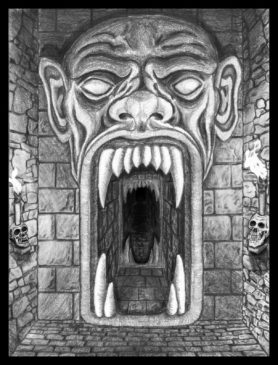
  • Helpful kobolds (yay reaction rolls!) and the talking stone head with laser eyes provide a lot of helpful information early on to the party: where are the (neutral) Korners, where is a significant magic item in the level.
  • The party avoided conflict when possible: bribing orcs with food, and having a wrestling match for sport, giving commitments to noble dwarfs, shooing giant rats away by setting rubbish on fire, feeding fire beetles, etc etc.
  • Iron spikes were sorely missed with self-locking secret doors. The Keeper of Secrets' riddle was answered with success, granting generous coinage, potions of healing, and a wand.
  • One of the most dangerous areas, the crypts of 2B, were treated with the utmost care and respect. There were several kerfuffles with ghouls and zombies. The latter claimed a couple hirelings.
  • Party decided to purse "Da Dragon" around session 6. The Thief purchased a chicken with the intent to lure or tame it. And despite successful sneaking efforts, the feeding plot was a disaster. I changed the creature a bit, giving it a gliding ability and two baby lizards. All whilst making the environment closer to a hothouse (aka players couldn't see the ceiling). Still it was a neat battle, and a Light spell saved the day. With 5500gp in treasure, I believe this was the biggest score of the (short-lived) campaign.
  • The invisibility trees of the Canyon level almost catches the party once due to a random roll. Would have been a perfect score for the bandits, since the party had a good chunk of treasure. Luckily, the PCs fled with arrows on their heels.
  • The Wheel of Fortune claimed a(n unlucky) Halfling, Mylo. Curiosity and foolishness was the end of him. The body is carried back to town, giving a proper burial.
  • Green slime was lethal! And one very hard to deal with challenge for the party. Fear the Slime!
  • There was a schism in the kobold faction: one loyal to Skiff and the Korners, the other led by a human lady with kobold workers fed up with their conditions. The players latched onto this conflict, but an action/outcome never materialized.
  • Players started then to use the Korners as a second base of operations. There were clear indications that Level 2 would be explored in the coming sessions (before the campaign petered), on suggestion of a dwarf noble in search of a dining Hall.
  • For some reason the players latched to an encounter with a cow god/spirit. Opening a church to it and moving that agenda forward also seemed to be in the pipeline. I guess it was material ripe for memes :-)

General Lessons Learned

  • By making fresh hirelings available every week, and any equipment at standard rates (including Plate), the PCs were carrying a lot of material, were very resilient, and rarely challenged by the hardships of the Dungeon. At least that was my impression.
  • The feast-or-famine nature of treasure was much commented. I sensed some frustration from the players. But in my opinion, this is a feature and not a bug of Stonehell (and early B/X as an extension).
  • It is hard to keep up with the Treasure Economy, once it starts to hit. B/X as written has even a 2nd level PC capable of acquiring all the equipment they want, several hirelings, war dogs, etc. Imposing taxes, jewellers and banks, carousing rules, etc. are left alltogether to the imaginative Referee and obscure supplemental materials. And it is often met with resistance from the players. This remains in my opinion a sore point of my games, and I understand why many don't want to engage in Dungeons & Dragons & Accounting if it carves out from your 2-3 hours of session fun-time in the week.
  • The trip back and forth to the dungeon was hand-waved, but it meant that, for the most part, carrying treasure out was a trivial endeavour. A single overland random encounter check could have made sense here.
  • We used a Caller role - someone to discuss options within the players, and make final decisions towards me - the Referee. This all in all worked well, especially in online play. With its awkward silences, there is always someone other than the Referee moving things forward.

Sunday, April 4, 2021

OSR: Stonehell Rival Adventuring Parties

There are good guidelines on Old School Essentials regarding the generation of rival adventuring parties (SRD here). And even a handy online generator to quickly have a new party created!

But as useful as that is, I want to shake things up a bit...

Generate a rival adventuring party with a dice drop, taking each of a kind from the full array (d4, d6, d8, d10, d%10, d12, d20) and reading all results at once from tables below. Let's assume the following example is for your favorite flavor of B/X, OSE, and for the Stonehell megadungeon.

Mind that there are light spoilers for Stonehell in the entries below!


d4-1 Thiefs
Number of Thiefs

d6 Fighters
Number of Fighters

d8 Level
Party member level (HD).
Divide by 2 (rounding up) unless in the levels of Into the Heart of Hell.
Leader is one level higher.

d10 Goal
1. Treasure!
2. Archaeological and architectural discoveries
3. Document Stonhell's inhabitants and the most exotic creatures therein
4. Holy quest to desecrate unholy shrines
5. Extract a specific magic items or bizarre curio
6. Make contact with the Vrilya
7. Find an exit to the surface. Utterly lost
8. Kill unaware targets with absolute impunity
9. Capture a high level Magic-User (1-in-20 they know about the Plated Mage [3B,3C,8E])
10. Redistribute wealth plundered in a stroke of altruism

d%10 Additional Members*
1. Magic User
2. Magic User
3. Cleric
4. Cleric
5. Dwarf
6. 2 Magic Users
7. 2 Dwarfs
8. Magic User and Dwarf
9. Magic User and Cleric
10. Magic User, Dwarf, and Cleric

d12 Unique Members
1. Halfling
2. Halfling
3. Halfling
4. Elf*
5. Elf*
6. Elf*
7. Pack of trained wardogs (2d3, as normal wolf)
8. Pack of trained wardogs (2d3, as normal wolf)
9. d2 trained bears (can use basic equipment), smoking cigars
10. d2 trained gecko lizard
11. Ogre
12. Troll, in search of the Great Hall [5C]

d20 Oddity
1. One of them is a doppelgänger
2. d4 are lycanthropes, werewolves or wererats (they are aware of the inhabitants of [3A])
3. They have a hefty bounty on their heads
4. Religious zealots, blessed (consult the d6 rolled: 1/ St Ras [0A] 2/ Lady Chance [1A] 3/ Duke of Bones [1A, 1B] 4/ Father Yg [2B] 5-6/ The Emperor God)
5. Are high on drugs, severe addicts. Hope Vaedium is the new hot narcotic
6. Armed with imported muskets, pistols, and blunderbusses. Know enough to operate them
7. Carry a cursed, chained magical tome. Dripping ichor and excreting fumes
8. Hungry and out of food. See the PCs as a source of calories
9. Roll on the section's random encounter table. Adventuring party at half HP, running away from that threat
10. Members of obscenely wealthy & famed mercenary company. Sigil visible. Wearing expensive capes and hats. PCs' retainers check loyalty or refrain from attacking/flee
11. Scarred and maimed delvers. 1-4 to surprise and detect/disarm traps, given extensive experience
12. Carrying a monster carcass, to be sold to the gentlemen ghouls [4D]. Are the PCs a score too?
13. This isn't the world they were born in
14. Followed by a retinue. Consult results on d4+d8. Beggars, cooks, barber-surgeons, bards, prostitutes.
15. Covered in flamboyant jewelry. 50% it's fake
16. Have d6 tablet scrolls (each 100 coins heavy)
17. Mercenaries of the Hobgoblin Occupational Army [2D]. Have orders to capture surface-dwellers if possible
18. Tons of inter-party conflict. Betrayal at the slightest chance
19. Have a magical compass that points to The Casino [7E]. If they have 4+ HD, they know where compass leads
20. Corrupted, mutated (unaware to them, by the Nixthisis)

ma-ko

*Notes:
-Magic Users and Elfs have sleep, and 2-in-6 chance of having whatever spell they need for the situation.
-Clerics have cure light wounds and 3-in-6 chance of having the appropriate spell prepared.

Friday, March 19, 2021

OSR: Stonehell OSE Open Table 1-10

Have been running an open table of Stonehell by means of OSE.
Players come and go, we do 1 delve = 1 session, and they have to return to town before we finish the game.

What follows are my highlights on how it's going after 10 x 3h sessions into this megadungeon.
No detailed notes this time. I lifted myself of that burden by giving the players an XP incentive for writing those, and posting them on our discord. So far they've proved a great resource (?).

Mild Stonehell spoilers ahead, be warned!


Some Highlights

  • Party scared to hell and back to enter a soot-filled room.
  • Wulfa the fighter wrestling with the orcs, with members of the party betting behind.
  • Getting treasure from the Keeper of Secrets by using their wits.
  • Sheperd the zombies from the crypts to attack the giant fire beetles.
  • Methodically hiring a small army to (magically) blind and hunt the dragon.
  • Pools of hot water? Future saunas?
  • The group getting peppered by arrows coming from the invisibility trees when leaving from the dungeon.
  • Mylo the halfling dying due to peer pressure to spin the wheel of Lady Chance. The group quickly pulled funds together to make the Mylo memorial wing at the healing house back in town.
  • Portcullises posing the biggest threat in the dungeon.

Stonehell Referee Notes

  • Dungeon is vast and dense. We have explored bits of the canyon and about half of level 1. Price to gaming ratio is just ridiculous. Stonehell should easily be 50$, the team who put this together is being robbed.
  • Awesome ideas abound! Probably Stonehell as written gets you 80% there, and filling in the remaining 20% with your own material is the way to go. Some new monsters were really good to read (e.g. doom lure), can't wait for them to appear.
  • That said, I have my gripes and terseness comes at a cost.
    •  ... factions are outlined, but are missing some strong motivation and extra oomph and flavor.
    •  ... some traps are just a "T" on the dungeon map, or secret doors a simple "S". Expanding this aspect is a must for the referee.
  • Treasure is scarce. Feast or famine. It's a design decision by Mr. Curtis, and I can see the reasoning behind and what it's trying to reinforce. But my players have complained about it, and it can get frustrating.
    •  ... have been giving extra XP for number of rooms explored in a session.
    • ... and for session reports. These are crucial given the open nature of our table to bring new players up to speed.
  • Stonehell could benefit from more loops and connections. Jaquays and Melan would wince at some of the sections.
  • Downtime is the big left-out in the OSR. There are a gazillion dungeons in the space. But common questions on how to pace and structure the game between delves is often neglected. Products and advice for this are missing. Although I get this is very personal from table to table: some people skip it, some allow magic items/potion purchase others not, etc. I don't blame Stonehell here, but it's just an observation.

Tuesday, January 14, 2020

OSR: Running Maienstein / Stonehell

Why Stonehell?

It's tough to assemble a game. My aim is to prepare one where the goal is clear, the rules are light and streamlined, and there's a big enough player base interested in playing games. This will be my first megadungeon run, and I choose Stonehell. Here's why:
  • It's dirt cheap. ~6$ for a 138 page megadungeon PDF. ~13$ for the softcover version (the first half of Stonehell, that is). I got both. Good and to-the-point writing. And if we get through that? There's a second tome detailing lower levels with the second part of the dungeon.
  • Layout is praised. And I can see why. It follows the one-page dungeon format. Seems like it would be fairly easy to run out of the book, with minimal page-flipping or rewriting.
  • Familiarity and gradual descent to strangeness. It covers the "trope" monsters and challenges one expects from a D&D game. This is good to introduce new players to the hobby. But it also gets weirder the deeper we get into the megadungeon. I like this design choice to not go full gonzo from the beginning.
  • It's got decent coverage on reddit/blogs/discords to the point that I can seek advice and guidance from the great minds on the internet.
I started running two tables of low frequency play-by-post through Discord.
This thing contains spoilers (duh..) to the Stonehell module. If you're sensitive to them, stop reading and go do something else.


Backdrop Setting

The premise for the game will be that player's are in an outpost town (let's call it Priebe), a good 2 days travel away from the biggest city, Maienstein. Region is full of dwarves, Maienstein being originally ruled by them. The city has contracted the Gold Griffon Curio Corporation to recover treasure from Stonehell, to finance their upcoming war against the rival port city of Seciras.

This gives me the chance to introduce an alternative for players bored of the megadungeon, and reaching a high level to go off rails. Joining a mercenary company in the upcoming war, abandoning Stonehell altogether, going into the politics of Seciras. And more importantly, a strong motivation of why the dwarves of Maienstein don't take care of plundering the riches of Stonehell themselves.

I will keep the distance from Priebe to Stonehell at 1/2 a day, and have a random encounter check to get there and back (x-in-y chance). This should be a mutating random table reflecting interesting humanoids, bandits, beasts or simple travelers, that spice up the game. Objective is not to keep the game out of Stonehell (that would be an error), but paint a picture of the setting (without front loading!) and that traveling is dangerous.

Minor Change

Level 1 of Stonehell features Kobolds and other staples of low-level adventuring. I'm fine with that focus on tropes, and will embrace it. But I will replace Kobolds with Molekin, and make them a deal more organized and unique. I dislike the 5e kobolds as little dragonkin. And it's a way to imprint the Ancestries I decided for Maienstein. Why kobolds? Choose the cute disgusting little buggers instead.

Molekin evolution, by Manuel Castañón

Rules

For ease of entry, rules will be my Knave hack, Knave++.

Keeping a reference document  available online at all times for the players is extremely important. With the rules, table etiquette, tone, and expectations too. This can be referenced during game (price lists, rules), used for character creation, etc.

There's no better advice than to eat your own dog food. At least 2-3 mechanics I want to tweak already. Inconsistencies can be ironed out. Players and friends can give excellent advice. I'm glad and blessed we can work on the game as we go.

I'm also putting together a Referee's Guide for Knave++. Which is nothing else than a compilation of my favorite mechanics and practical advice on how to run a game. Overloaded encounter die, mechanics, etc.

In this discussion we get some advice on tracking turns for depleting resources and random encounter checks when exploring a dungeon complex. Food rations, water, torches, lamp oil, etc. This is very important for this type of game. Luckily, Stonehell already has encounter tables for each section of the dungeon, and I will be using the overloaded encounter die mechanic.

Learning to Megadungeon

 
... one level at a time

Cohesiveness is important, and frankly seems to be the selling point for such a campaign. Especially when comparing to a fun-house dungeon or a smaller dungeon. Levels should have themes, in its inhabitants, architecture, and current state.

Restocking tables, to keep things fresh. If the PCs explore and clean of monsters an area, it should remain alive. Don't want to keep the PCs "cleaning" the same level over and over again, but the environment changes and mutates.
Pg 9 of Stonehell has some basic guidelines on how to restock the dungeon, and remain it an ever-changing environ.
Each level can have its own theme, but there should be a cross-section. Short cuts. Loops. Vertical connectors.

This article is a good write-up with advice on how to run these kind of games. Key takeaways are:
  1. Decide on grid vs loose mapping (and more importantly, who is doing that, the players, the referee?).
    This point is the one that's biting my ass at the moment. The game will be fully online, using Discord as the platform of choice.
    It would be fairly easy for me to clean the dungeon maps from the PDF, remove room keys, and use fog of war or similar.
    But that might be too forgiving for the players.
    So if we want to draw a map (and account for a PC or hireling doing so!), what best? I doodle the map? Should the players draw my painstaking descriptions? I have no answer.
  2. Make sure there are enough loops, and branches present informed choices for the players.
    Stonehell design leans to this structure already.
    During the game, I have to remind myself to present choices to the players.
    An interesting trick is to provide maps/rumors, and the mole market of level 1 could be excellent for that.
  3. Random encounters should be more interesting than "2d6 kobolds molekin".
    Maybe tying them to factions in the megadungeon?
    Additional roll for flavor/situation and lookup on separate table?
    How much content can I generate on the fly without over-saturating?
  4. Traps should be interesting enough to encourage interaction, but safe enough to avoid skipping them be the default behavior.
    This link provides additional traps for the megadungeon.
    • ... on a similar note, secret doors should be explained in the environment, and another opportunity for interaction with the environment. 
    • ... there should be an obvious benefit for trying to interact/overcome the trap.
      Be it treasure, a door, a key. Show 'em the carrot!

    Certainly there's a lot more to learn about the fine art of running a megadungeon like a boss.
    But baby steps, these 4 pointers (+ tracking of player resources via turns) seem like an ambitious but logical first goal.

    Given the price of the softcover, I will use it as a workbook, and just go all crazy on it. Color-mark entries (monsters=yellow, traps=green, treasure=blue) on each dungeon section page. And add post-its for each major section. This will help me reference the material when running, and spotting rooms quickly.

    Take them markers out, pal!

    Logistics

    Justin Alexander has a series of great articles about running an open table.
    They provide a great framework for me to phrase and write down the logistics to this campaign.
    • Quick Character Creation & Easy Access Systems: Knave is perfect for this! Sprinkling a couple extra random tables (Ancestry for instance) to bring forward even more OSR
    • Open Group Formation: not really the case here. But megadungeons are great it a player decides to drop off the game. Knave characters are mostly defined by their equipment (and in our case, an Ancestry and couple Knacks). So no big issue if the thief is sitting out this delve, just purchase the right equipment and cover for them.
    • Default Goal & Default Action: get treasure. Get it from Stonehell. Spend it for XP. Simple. Clean.
    • Regenerative / Extensible Content: Stonehell comprises two books, at about 280ish pages of megadungeon to explore. Pg. 10 mentions there are several opportunities to add extra custom levels/rooms (which I could do if I wanted). Restocking too. Frankly, there's plenty of game in here. Running out of content is not within my worries.
    We are doing most of the game on Discord, with rolls done with a bot, and we have a game wiki to store the character sheets and most important information.

    The biggest pain I have at the moment is with regards to mapping. Roll20 is nice as it lets me share a full blown grid map, but is very overblown for the task, and not mobile friendly (and a lot of times players post on their phones). For now I'm using google drawings, and looking for better alternatives. 

    Campaign Time Management and upkeep costs during downtime will be winged, assuming PCs have a place to stay and basic food at Priebe. A 300 day calendar (10 30-day months) seems sensible, and is easy to remember. In-game time during a megadungeon should stay fairly low, so I'm not too worried about continuity. Characters returning to Priebe will be enforced to cash in loot for XP, although I could allow an outpost if the players are really clever and resourceful about it.

    Unsorted To Do List

    Games are pretty much started, but in early stages. Very early ones. The we-are-exploring-the-canyon stage. But I'm having a blast so far. And the PbP is very suited for this sort of megadungeon play. Content will be added and fleshed out pretty much as we go. So here is a short list of things that should get done (I will link in case any develop to their own post):
    • Finalize the Referee's Guide to Knave++.
    • Find a bloody mapping solution! For Discord and mobile play.
    • Regional hexmap of the Stonehell area in the Maienstein area. Good excuse to finally use HexKit.

    Tuesday, November 12, 2019

    Knave Ancestries for Maienstein / Stonehell

    A setting can be informed and presented to the players through several means. Probably the worst one is prescriptive, with a lot of given names, and with pages and pages of (for play mostly) irrelevant lore. What happens at the table is key. What directly concerns the characters is key. The rest, although interesting for the referee to build, takes a distant second stage.

    One excellent way to create a setting is answering Jeff's 20 questions, which I am a big fan of.

    Another complimentary one is with the available list of Ancestries (I personally prefer this to the term Race). Ancestry should be rolled for, and not chosen. The campaign's available Ancestries inform the civilizations present in the country/continent/barony, and we can distribute that with the dice choice. 2d6 is excellent. The following table is adapted from this Skerples table.

    The following table is meant for my Knave hack for a Stonehell megadungeon game I have in the workings (see games I want to run). It informs the Maienstein region within Five Towns, full of dwarves and mountains. Players choose their Ancestry randomly by rolling. It also shows the likelihood for someone of said Ancestry to become an adventurer, dungeon delver or treasure hunter (or in the case of Fauns and Jotuns, there simply aren't many of them). Below there are visual hints, a bit more description, and facts about each Ancestry in my Maienstein - Five Towns setting. I hope to get this Stonehell game ready soon!


    2d6 Ancestry Improved* Bonus Malus
    2 Faun CHA Eat half as many rations Cannot tell the direct, blunt truth
    3 Spiderling INT Can secrete 30' of rope per day Cannot see more than 30'
    4-5 Dwarf CON No penalties for broken or hilly terrain Pervasive, unique stink
    6-8 Human Choice Start with 1 extra Dungeoneering Gear item Disadvantage to resist being mutated or transformed
    9-10 Halfling DEX Can have 2 Snacks** per day instead of 1
    -2 Inventory Slots
    11 Molekin WIS Can crawl through narrow spaces Save vs Fear when alone
    12 Jotun STR Can see details at a great distance Massive. Disadvantage to stealth rolls

    * An Improved stat means that at character generation you give a +1 to the relevant stat.
    ** Snacks in this context is basically eat a ration to regain some HP, a little rule of my Knave hack Knave++

    2 - Faun

    Fey touched creature, by Oliver Wetter

     Elder Faun, by Darya Kozhemyakina


    • Lifespan: up to 200 years, adulthood at around age 30.
    • Size: most Fauns go above 6 feet tall, with slender and thin figures. They don't need much food. Some rumor they feed on other creatures' truths.
    • Sample Names: Ekaraj, Yadav, Praveen, Uttam, Rojina, Nikeeta.
    • Features:
      • Antlers on the head and hooves instead of feet. Pointy ears due to their obvious Fey lineage.
      • A mock within Fey society, but mystic and respected within mortals. Since Elves became almost extinct, Fauns are slowly taking their place as graceful alien creatures from another place.

    3 - Spiderling

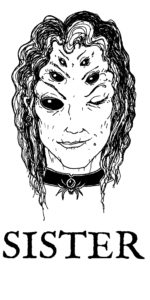
    A Spiderling called Sister, by Bearded Devil
     
    • Lifespan: (same as a Human) up to 70 years. When a Spiderling dies they turn to webs, which ultimately crumble to dust. Their souls return to the ether web, to be cleansed of any memory, and return as a new egg to start a new life.
    • Size: average at about 5 feet tall.
    • Sample Names: Abby, Nicolette, Clothilde, Laetitia, Victoire.
    • Features:
      • Many eyes, and with that many inputs it makes it hard to process. Therefore a Spiderling's sight is considerably weak. Huge bottom, due to their spider heritage.
      • Spiderlings are linked to each other by the ether web, and can connect telepathically to one another. They share this trait as a hive-mind.
      • Their sex is fluid and non-binary. A Spiderling can change it at a thought's notice to whatever suits their wishes.

    4 - 5 Dwarf


    Dwarf by Sergio Artigas
    • Lifespan: on average a Dwarf lives up to 300 years. However, dying of old age is proof of a life not lived to the fullest, and is seen as a disgrace. Greybeard being a derogatory term. As a consequence war, drink and smoke are performed to the fullest.
    • Size: between 4 and 5 feet.
    • Sample Names: Ulrik, Harnof, Ilga, Olov, Alvin, Lizette.
    • Features:
      • Stocky and heavy, with secure footing.
      • Admirable resistance to drugs and narcotics, which they gladly put to the test at any chance.
      • Both male and female boast over their impressive beards. They might be hard to tell apart for Humans.

    6 - 8 Human


    Always ready! Humans by Charles Lin
    • Lifespan: on average a Human lives up to 70 years, although lifespan varies greatly.
    • Size: between 5 and 6 feet tall. But humans come in many shapes and forms.
    • Sample Names: (in the Maienstein region) Eros, Mendaur, Didako, Ibon, Antonia, Latxa.
    • Features:
      • Capable of the best and the worst, humans are versatile and work best in groups.
      • They helped consolidate Five Towns as a distant region of the Itean Empire, the obedient ants of Nemes, the Immortal Empress.

    9 - 10 Halfling


    Halfling by Cale Fortin
     
    • Lifespan: Halflings live up to around 90 years of age. Larger lifespan than Humans, but shorter than other Ancestries.
    • Size: average of about 3 feet, they are light and nimble. Obviously, hairy feet.
    • Sample Names: (same as Humans) family name is far more important: Ironheart, Buttercheeks, Potter, Nimblefeet, Jamjar.
    • Features:
      • Nimble and petite, halflings are in general weak due to their size.
      • Jovial and talkative. Surprisingly loud voice. The center of any party. Some find that amusing, others abrasive.
      • Halflings integrate well into any society and civilization, and are seen as a necessary boost to morale in any group, town, or city.

    11 - Molekin


    Molekin evolution, by Manuel Castañón

     
    • Lifespan: Molekin are short lived given their high mortality rate. Known to die at around 60 years on the rare instance of passing away of old age.
    • Size: between 2 and 4 feet tall, they average at around 3 feet.
    • Sample Names: Snot, Pimple, Cough, Stye, Rash.
    • Features:
      • Stronger than their size might suggest.
      • Molekin live in large communities underground (tunnels, abandoned dungeons, mines, etc.), where they spread like vermin. Isolation breaks their minds.
      • Molekin gladly take leftover jobs of any society: tending to sewers, cleaning stables or piling fertilizers. Hard time integrating.

    12 - Jotun


    Jotun Hunter, by Mark Hretskyi


    • Lifespan: Jotuns live exactly 100 years. As they age, their bodies start to slowly turn into stone. A Jotun dying of old age is a culmination of this process, and their statues are priced treasures within Jotun society.
    • Size: Jotuns have the blood of Giants flowing through their veins. Ancient unattended children of these behemoths, they boast a considerable size between 7 and 8 feet.
    • Sample Names: Boulder, Tusk, Flint, Drift, Mist, Steam. Jotuns take as name the first object they remember from their childhood.
    • Features:
      • Tall and strong, very acclimated to great heights.
      • Eyesight as good as an eagle's. Some have antlers, others don't.
      • Jotuns live in sparse remote areas, and are suspicious of intruders, strangers, and travelers alike.