Monday, November 18, 2019

Knacks for Knaves

This is version 1.0 1.1 of some powers for Knave, with aim to be a modern interpretation of old B/X rules for play in my games. Knacks for Knaves. First use for them will be a run on a megadungeon aimed at Labyrinth Lord, Stonehell. They will be part of the Knave hack I'm working on for said game, after I tackled Ancestries, now come a concept similar to Class. Special abilities and powers called Knacks, that give that power advancement feel.

Some scattered notes on adding these to the streamlined machine that Knave is:
  • For a recurring campaign, players should feel enticed to gain new powers as they level up (aside from gear and coin, of course). Knave is very strong for one-shots or short games, but how good does it hold up for longer campaigns?
  • We make them optional. Idea is to give to choice of score improvement (default choice with vanilla Knave), or take one of these powers to the players. Hopefully most will choose the latter.
  • We give choice. 48 Knacks, no less. They are also completely independent, so there's no requirement to pick any Knack. Of course there are obvious synergies, but that's for the Munchkin players to figure out.
  • They are not balanced between each other. Things like Blind Faith and Student of the Arcane will be picked a lot, since they are basically the spellcasting for Cleric and Magic User - like characters.
  • In my Knave hack I took spellcasting from GLOG, since my love for the Magic Dice mechanic is unconditional. You will see references in the entries below about that. Blind Faith introduces spellcasting for Clerics, which is a different mechanic, with Prayers (but more reliable than MD are).
As any good Thief, I've taken many of these powers from different sources. I rest on the shoulders of heroes. They're meant for personal use in my home game, and if you find use for them that's an achievement.

Knacks for Knaves - The Rules


The Doc In case you want to have a living document to print out, or leave me some commentary

Knaves start at Level 1 with one Knack from the list below of their choice.

When a Knave gains a level, instead of increasing a single Ability Score by +1 a Knave may select one Knack from any of the categories below, without restriction. Limited to one Knack per level up.

The categories are for flavor only, and very broadly separate Knacks into different buckets.

Values within squared brackets [] are variable.

WARRIOR (Knacks of War)

A knight with the "Great Weapon Fighter" Knack, by Valery Klishevich

  • Duelist: On a critical you may choose to either:
    • Disarm your foe (assuming this is possible), or
    • Put them on the backfoot, granting you Advantage on your next attack or stunt.
  • Great Weapon Fighter: when wielding a two-handed weapon, reroll damage < 3. Keep the second result. 
  • Protector: Sacrifice your Action to absorb damage inflicted on an adjacent ally. STR save for half-damage.
  • Riposte: When a creature misses you with a melee attack, make an immediate counter-attack. This does not cost you your normal Action. Only possible once/round.
  • Shield Master:
    • Advantage on STR attempts to knock an opponent prone w/a shield bash.
    • When an effect allows a DEX save for half damage take no damage if you save as your shield absorbs the blow (-1 quality to shield).
  • Two-Weapon Fighting: When you hit a foe while wielding two weapons, roll damage for both and apply the higher.

BARBARIAN (Knacks of Brunt) 

Barb with "Muscle Armor", by Daniel Zrom

  • Berzerker: When reduced to 0HP, become frenzied and continue fighting for a number of rounds equal to your [Level]. You always attack the nearest creature whether friend or foe. Afterwards, make a CON save. On a fail, roll on the Death and Dismemberment table.
  • Pugilist: Your fists and feet count as martial weapons and inflict 1d4+[STR bonus] damage.
  • Girded Loins: You have Advantage on saves made to resist fear and mind bending effects.
  • Favor of The Gods: Once a day as a free action you can heal [CHA bonus] HP. 
  • Muscle Armor: CON is your Armor Defense when you wear no other armor. May wield a shield or helmet.
  • Cleave: When you strike and kill a foe immediately make another attack on an additional adjacent foe. Cannot be “daisy-chained” through a mob.

SCOUT (Knacks of Wild)

The hunt is mine! Michelle Tollo

  • Hunter’s Mark: As a free action once per day, mark your target as living on borrowed time. You have Advantage on your next [Level] attacks against them.
  • Deft Quartermaster: Your rations, potions, and equipment from the Dungeoneering Gear in the Starting Gear section can be bundled two to an inventory slot.
  • Survivalist: You thrive in the Wilds protecting the realms of Man from the horrors that lurk in dark wood and deep cave. You have Advantage on saves to track, navigate, hunt, and forage in the wilderness.
  • Trick-Shot: Targets only receive half of their normal cover bonus. When you shoot into melee enemy combatants count as two combatants for the purposes of randomly determining who you hit.
  • Night Vigil: When camping, you can gain advantage on the encounter die after describing your watch routine and setting up a perimeter by means of your choosing.
  • Skirmisher: Immediately after you are attacked in melee, you can move up half your speed without provoking opportunity attacks. Once per round.

ROGUE (Knacks of Trickery)

Daria Rashev

  • Acrobat: You gain Advantage on saves to balance, climb, leap, and tumble.
  • Burglar: You gain Advantage on saves to hide in shadows, move silently, and climb.
  • Backstab!: When you attack a foe with a melee weapon who is already engaged by an ally inflict an addition 1d6 per [Level] damage. You attack with Advantage if you attack from hiding.
  • Dungeoneer: You have Advantage on DEX saves to disable traps, assuming you have the proper tools. Three times per day you may ask any of the following questions and must be given an honest answer:
    • Is there a trap here? (Y/N Answer)
    • Is there a hidden door here? (Y/N Answer)
  • Lucky AF: Once per day you may reroll a Critical Fail or force a foe to reroll a Critical Success that would affect you.
  • Evasive MF: Once per round you can reduce damage taken by your [DEX bonus], if you can see its source.

CLERIC (Knacks of Faith)

Xabi Gazte

  • Blind Faith: Take a sacred oath with your faith/authority. You gain the ability to use Clerical Implements (bells, candles, herbs or similar), and gain one. You can use it with one hand to say Prayers.
  • Turn Undead: [Level] times per day, force up to [WIS bonus] HD worth of undead to make a morale check using your action. Apply a negative modifier equal to your [WIS bonus] to the check.
  • Pacifist: Whenever you get a reaction roll to resolve a situation that could end up in combat, if you and your allies remain calm, the roll is with Advantage.
  • Hammer of The Authority: Grant Advantage to any morale checks your retainers/hirlings/acolytes make as your below a holy litany and lay waste with your warhammer.
  • Sacred Feast: Out of combat you can bless Rations or Snacks that are meant to regain HP with your Clerical Implements. Creatures add your [WIS bonus] to their HP healed.
  • Witch Hunter: You smell the presence of Magic Users, Witches, or other Clerics.

DRUID (Knacks of Nature)

Druid with mutated "Owl Eyes" by Rebecca Blackie

  • Bear Strength: Gain +2 Item Slots. This allows you to go above the 20 Item Slots limit.
  • Gliding Wings: You have gliding appendage wings below your arms. You don't take any damage from falling, as long as you can extend your arms.
  • Owl Eyes: Gain darkvision. Useless the moment there’s a light source present (sunlight, torch, candle, lamp).
  • Spider Feet: For [Level] of turns per day your bare hands and feet allow you to walk on vertical surfaces or upside down without the need of equipment or saves.
  • Animal Talk: You can verbally communicate with animals as if you shared a language. This doesn't make them smart. 
  • Forest Step: You can step from one tree to another, as long as they are on the same grove/forest/garden, [Level] times per day.

MAGIC USER (Knacks of Magic)

Getting a "Student of the Arcane" Knack, by Albert Urmanov

  • Student of the Arcane: Gain 2 random spell books. You have a number of Magic Dice (=MD) equal to your [Level]/2 (rounded up). All saves associated to casting arcane spells are based on your INT.
  • Sword Wizard: You can cast spells while wielding a weapon in one or both of your hands. You still need the spell books/scrolls/magic items on your own inventory.
  • Manifold Cerebrum: You have Advantage on INT Saves vs magical attacks/effects.
  • Companion: Gain a mystical cat (darkvision) , mouse (burrow), squirrel (climb) or toad (swim) companion with [Level] HP. You can communicate with it telepathically as long as you can see it. If it dies it can be re-summoned spending a night’s work.
  • Spell Tattoos: Your skin is covered with tattoos of magical glyphs. Anyone who sees them knows what you are. Gain one random spell (roll [INT bonus] times and choose one). Whenever you cast this spell, do so with +1MD (this die doesn't return to your pool). You still require MD and free hands to cast the spell.
  • Chaos Mage: Gain one random spell to cast from your mind per day. Each morning roll [Level] random of spells and pick one to store for the day. Whenever you cast this spell, do so with +1MD (this die doesn't return to your pool). You still require MD and free hands to cast it.

WITCH (Knacks of Wyrd)

Witching around, by Tatyana Kupriyanova

  • Read Leaves: Assuming you have water, a pot, and tea, you can spend 1 turn every morning performing this ritual. Roll a d20 and store that number. You can replace a result on a d20 from a creature you can see (yourself, allies, or foes) once that day with the stored number. You do this after learning the roll, but before knowing the outcome.
  • Familiar: You gain a mouthless humanoid, magically created with mud and sticks. d8 + [Level] HP. Doesn't eat or drink, but needs to breathe. Follows all your commands, although it's extremely incompetent in combat. You can resummon your familiar 1/day.
  • Spell Eater: Once per day when a spell is targeted at you, you negate the spell's effects. Do A CHA save. On success, you absorb the spell and can cast it once as if it were your own, with the MD the rival intended for the casting. On a fail you need to eat double the rations for one day. You can only have one eaten spell at any time.
  • Devil's Contract: If someone makes a bargain with you and breaks it you instantly know about it. If you have their signature on the bargain you know how to locate them by general location (North, East, up down, etc.)
  • Hint/Jinx: Once per turn do a CHA Save when another creature you can see attempts an action that requires a d20 roll. On success, add(hint)/subtract(jinx) your CHA bonus to the roll. On a failure, you loose [Level] HP. You do this after learning the roll, but before knowing the outcome.
  • Alter Ego: Choose a second persona of your same Ancestry, regardless of features, sex and age. You can shapeshift to that persona a total of [CHA bonus] hours per day.

Tuesday, November 12, 2019

Knave Ancestries for Maienstein / Stonehell

A setting can be informed and presented to the players through several means. Probably the worst one is prescriptive, with a lot of given names, and with pages and pages of (for play mostly) irrelevant lore. What happens at the table is key. What directly concerns the characters is key. The rest, although interesting for the referee to build, takes a distant second stage.

One excellent way to create a setting is answering Jeff's 20 questions, which I am a big fan of.

Another complimentary one is with the available list of Ancestries (I personally prefer this to the term Race). Ancestry should be rolled for, and not chosen. The campaign's available Ancestries inform the civilizations present in the country/continent/barony, and we can distribute that with the dice choice. 2d6 is excellent. The following table is adapted from this Skerples table.

The following table is meant for my Knave hack for a Stonehell megadungeon game I have in the workings (see games I want to run). It informs the Maienstein region within Five Towns, full of dwarves and mountains. Players choose their Ancestry randomly by rolling. It also shows the likelihood for someone of said Ancestry to become an adventurer, dungeon delver or treasure hunter (or in the case of Fauns and Jotuns, there simply aren't many of them). Below there are visual hints, a bit more description, and facts about each Ancestry in my Maienstein - Five Towns setting. I hope to get this Stonehell game ready soon!


2d6 Ancestry Improved* Bonus Malus
2 Faun CHA Eat half as many rations Cannot tell the direct, blunt truth
3 Spiderling INT Can secrete 30' of rope per day Cannot see more than 30'
4-5 Dwarf CON No penalties for broken or hilly terrain Pervasive, unique stink
6-8 Human Choice Start with 1 extra Dungeoneering Gear item Disadvantage to resist being mutated or transformed
9-10 Halfling DEX Can have 2 Snacks** per day instead of 1
-2 Inventory Slots
11 Molekin WIS Can crawl through narrow spaces Save vs Fear when alone
12 Jotun STR Can see details at a great distance Massive. Disadvantage to stealth rolls

* An Improved stat means that at character generation you give a +1 to the relevant stat.
** Snacks in this context is basically eat a ration to regain some HP, a little rule of my Knave hack Knave++

2 - Faun

Fey touched creature, by Oliver Wetter

 Elder Faun, by Darya Kozhemyakina


  • Lifespan: up to 200 years, adulthood at around age 30.
  • Size: most Fauns go above 6 feet tall, with slender and thin figures. They don't need much food. Some rumor they feed on other creatures' truths.
  • Sample Names: Ekaraj, Yadav, Praveen, Uttam, Rojina, Nikeeta.
  • Features:
    • Antlers on the head and hooves instead of feet. Pointy ears due to their obvious Fey lineage.
    • A mock within Fey society, but mystic and respected within mortals. Since Elves became almost extinct, Fauns are slowly taking their place as graceful alien creatures from another place.

3 - Spiderling

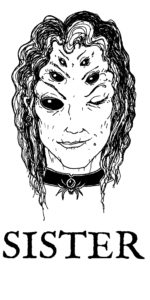
A Spiderling called Sister, by Bearded Devil
 
  • Lifespan: (same as a Human) up to 70 years. When a Spiderling dies they turn to webs, which ultimately crumble to dust. Their souls return to the ether web, to be cleansed of any memory, and return as a new egg to start a new life.
  • Size: average at about 5 feet tall.
  • Sample Names: Abby, Nicolette, Clothilde, Laetitia, Victoire.
  • Features:
    • Many eyes, and with that many inputs it makes it hard to process. Therefore a Spiderling's sight is considerably weak. Huge bottom, due to their spider heritage.
    • Spiderlings are linked to each other by the ether web, and can connect telepathically to one another. They share this trait as a hive-mind.
    • Their sex is fluid and non-binary. A Spiderling can change it at a thought's notice to whatever suits their wishes.

4 - 5 Dwarf


Dwarf by Sergio Artigas
  • Lifespan: on average a Dwarf lives up to 300 years. However, dying of old age is proof of a life not lived to the fullest, and is seen as a disgrace. Greybeard being a derogatory term. As a consequence war, drink and smoke are performed to the fullest.
  • Size: between 4 and 5 feet.
  • Sample Names: Ulrik, Harnof, Ilga, Olov, Alvin, Lizette.
  • Features:
    • Stocky and heavy, with secure footing.
    • Admirable resistance to drugs and narcotics, which they gladly put to the test at any chance.
    • Both male and female boast over their impressive beards. They might be hard to tell apart for Humans.

6 - 8 Human


Always ready! Humans by Charles Lin
  • Lifespan: on average a Human lives up to 70 years, although lifespan varies greatly.
  • Size: between 5 and 6 feet tall. But humans come in many shapes and forms.
  • Sample Names: (in the Maienstein region) Eros, Mendaur, Didako, Ibon, Antonia, Latxa.
  • Features:
    • Capable of the best and the worst, humans are versatile and work best in groups.
    • They helped consolidate Five Towns as a distant region of the Itean Empire, the obedient ants of Nemes, the Immortal Empress.

9 - 10 Halfling


Halfling by Cale Fortin
 
  • Lifespan: Halflings live up to around 90 years of age. Larger lifespan than Humans, but shorter than other Ancestries.
  • Size: average of about 3 feet, they are light and nimble. Obviously, hairy feet.
  • Sample Names: (same as Humans) family name is far more important: Ironheart, Buttercheeks, Potter, Nimblefeet, Jamjar.
  • Features:
    • Nimble and petite, halflings are in general weak due to their size.
    • Jovial and talkative. Surprisingly loud voice. The center of any party. Some find that amusing, others abrasive.
    • Halflings integrate well into any society and civilization, and are seen as a necessary boost to morale in any group, town, or city.

11 - Molekin


Molekin evolution, by Manuel Castañón

 
  • Lifespan: Molekin are short lived given their high mortality rate. Known to die at around 60 years on the rare instance of passing away of old age.
  • Size: between 2 and 4 feet tall, they average at around 3 feet.
  • Sample Names: Snot, Pimple, Cough, Stye, Rash.
  • Features:
    • Stronger than their size might suggest.
    • Molekin live in large communities underground (tunnels, abandoned dungeons, mines, etc.), where they spread like vermin. Isolation breaks their minds.
    • Molekin gladly take leftover jobs of any society: tending to sewers, cleaning stables or piling fertilizers. Hard time integrating.

12 - Jotun


Jotun Hunter, by Mark Hretskyi


  • Lifespan: Jotuns live exactly 100 years. As they age, their bodies start to slowly turn into stone. A Jotun dying of old age is a culmination of this process, and their statues are priced treasures within Jotun society.
  • Size: Jotuns have the blood of Giants flowing through their veins. Ancient unattended children of these behemoths, they boast a considerable size between 7 and 8 feet.
  • Sample Names: Boulder, Tusk, Flint, Drift, Mist, Steam. Jotuns take as name the first object they remember from their childhood.
  • Features:
    • Tall and strong, very acclimated to great heights.
    • Eyesight as good as an eagle's. Some have antlers, others don't.
    • Jotuns live in sparse remote areas, and are suspicious of intruders, strangers, and travelers alike.

Tuesday, November 5, 2019

Dead by Dawn - Review & Redux

Dead by Dawn is a starting adventure for Shadow of the Demon Lord, meant for characters of level 0. This is a funnel. And an interesting one at that. I've played the adventure once, and ran it 3 times. As it is only 1.5$, I'd say for me it already paid for itself.

The setup is extremely straightforward, and includes interesting mechanics to resolve the situation without the whole session turning into a drag-fest (not that kind though). But perhaps I'm getting ahead of myself.


This thing contains spoilers (duh..), so if you're sensitive to them, stop reading and go do something else.


Adventure Summary & Review

"Even as the darkness from the Void casts its shadow across Urth, there are other dangers found lurking in the gloamings of the world. Some perils seek to entrap the innocent. Some are never defeated, their evils only delayed for a time. And at least one hungers for blood and meat to sustain its immortality. Tonight, this horror sets out to feed its vile hunger with fresh flesh."

The Goathorne Inn stands on the side of a secluded road. It's close to a gloomy forest of your choice, and far enough of civilization to make it isolated. Characters arrive to the two story building and are met by 3 folks: a pair of dwarven ladies, retired mercenaries, Ananda and Gelda, and Bester, the helping boy. There's a 4th NPC in the building, a priest of the Old Faith named Horvath, who unbeknownst to the innkeepers, has been dead for about a day.

Initially, players are allowed tavern shenanigans. They get to roleplay and get to know each other in character, and meet the two dwarven ladies and Bester. Heavy rain pours outside, so a warm drink & meal should sound like an inviting offer. Depending on your group they might get really into it, but you have a way to move the action forward with the dinner.

The Good

  • Premise of the adventure is simple but brilliant. There's a sense of dread, and a ticking clock that can explode in the PCs faces at any moment. An adventure has to feel like a tray full of half-empty drinks currently balance by a pin needle. Then you throw the players on top, and see where all falls.
  • Space is confined, very much so! There's an inn. That's it. Makes the situation nice and controllable. As written though, it could use some expanding. More to it later on.
  • Splitting the resolution into 2-hour chunks is also clever and elegant, to keep the session in order and things moving forward. This mechanic is nice, although the "Siege Encounters" table on pg 6 can use some adjusting depending on the number of PCs in the inn.

The Bad

  • There are three NPCs in this adventure: Ananda and Gelda (the dwarven ladies), and Bester (the helping boy). As presented, the NPCs are a tad dull, and the most you get is a silly gimmick of how the dwarves pronounce the name of their inn. This needs spicing up! We need a creepy and crazy NPC that shills that "Dark Souls/Warhammer Fantasy" feel to the players.
  • This adventure features exactly one adventure, the Goathorne Inn. There's no map. Art is expensive, I get it. But this is a massive missed opportunity, and should have been included as part of the adventure. There are detailed descriptions, but the less I have to parse from text, the better.
  • No mechanic for escaping the inn. It should be virtually impossible to do so during the outbreak, but I would've appreciated some commentary or mechanics on how to handle clever and innovative players that decide to make a run for it.
  • Useless roll are not good adventure design. Repeat with me: do not make your players roll if there are no strict consequences. From the text: " Once he is dispatched, have bitten characters make Strength challenge rolls with 1 bane. There’s no effect on a failure or a success, other than to raise the tension". Not my cup of tea.
  • Layout and art minor issues here and there. The "Unexpected Events" table is split in two pages. The 2 pieces of art are... not indicative at all from other SotDL products. I don't want to dunk on the artist. But it just doesn't fit the theme and adventure.
Don't be fooled by the dominance of negative points. I tend to find flaws and not praise the good! This is a very good adventure.

Some Hacks - The Redux


Let's face it... your dwarven ladies need beards
The PDF where I write notes and attempt to enhance the adventure
  1. Spice up the NPCs in "Getting Started".
    • Remove Bester (as presented, he's quite dull), and add Old Sam (Commoner), that's an old wicked human (sounds like Old Man Touchy) who talks about "certain Doom if you succumb to weakness and violence", "you reek of Corruption". He's creepy, but harmless. The dwarven ladies let him stay in the common room and serve him a pot of stew a day in exchange to tending their beasts at the stable.
    • Make Ananda very troubled and mentally scarred. That Insanity 3 has to shine.
    • Make Gelda behave like a sergeant, giving orders and cussing like a sailor.
  2. In "Death For Dinner" have a clear trigger for what makes Horvath rise, deliver the line and attack. As presented, it seems he acts arbitrarily (after the PCs have explored the room a bit). Make it be anyone touching the corpse for examination of the cause of death will awaken Horvath.
  3. Create a random table to spice up where the bodies break in in the "Encounter Resolution Phase". Locations in the first floor to be weighed in more heavily, but cellar and second floor should be a possibility.
  4. Complicate the plot by adding interesting things inside the inn (after the outbreak). This point ties to #1 above.
    • The adventure is vague as to what there is on the inn. I would suggest adding a couple of cooking knifes (daggers), 2 barrels of ale, 2 casks of oil (used for lamps and cooking), a shovel, and 50 ft of rope.
    • Let's convert the Zombie Apocalypse of this adventure into Zombie Apocalypse + Hateful Eight. This serves two purposes: first, to allow the introduction of new (hidden) characters that players can pick up when theirs ultimately succumb, and secondly, to force more tension within the inn (by the way of conflict).
    • The same day of Horvath's demise, the following happened: there is an Orc cook lady called Pliers. She was getting some action in bed with Ananda, ultimately cheating on Gelda. Unbeknownst to them, they get peeped by naughty boy Bester (a la Game of Thrones). Pliers notices this last time mid-act, and kills him out of rage in a moment of stupidity (instead of buying off the boy's silence, which was the sensible thing to do). Gelda now did find out, subdued the Orc employee, and was in the middle of torturing her in the cellar (with the help of her old mercenary "tools"), and removed her right eye. And then the PCs arrive.
    • Above circumstances forced Gelda to move the ale barrels to a spare room on the 2nd story of the inn. This room is locked, and additional to the 4 suites described in the original text. We place the rest of equipment I described in the first point here as well.
  5. The conclusion to Dead by Dawn as presented happens under two circumstances: PCs either survive till dawn (5 x 2-hour shifts during the night), or their faces get eaten by a swarm of undead creatures. But we all know groups will attempt to get creative. Especially when the odds are stacked against them, and things are spiraling down.
    • Write down possible escape routes and plans during the night. It should be tough, but don't negate clever player ideas.
    • Some escape options might include:
      • Throw lit oil through a window, cause a fire, and flee through another window in the opposite direction.
      • Confront Gelda, take all food and supplies to the cellar, and start digging a tunnel.
      • Cover yourself in guts and feces, and try if you are undetected by the walking corpses.
      • ... etcetera

Conclusion

Midnight snack, by Joao Fiuza

If you are slightly interested in SotDL, buy this thing. And run it. In my opinion it's an excellent introductory adventure to Shadow of the Demon Lord. Better than the recommended Dark Deeds in Last Hope if your players prefer action-packed stuff (and they usually do), and you need less hand holding to run a game.

Sunday, October 20, 2019

Passing Time in Town

Some important considerations:
  • This is for my Castle Nowhere game using a mash of Into the Dungeon and GLOG rules.
  • We decided to not use a gold=XP system, and instead advance characters based on the number of sessions played, as Into the Dungeon prescribes. I can see this working nicely in such an advancement system though.
  • Some of the entries are shamelessly lifted from the Jeff Rients article on Carousing.
  • Note that sp are the common currency, and that a simple weapon costs 1sp, a meal+bed at an ok inn are 2sp.

Characters can opt to spend their time back in town doing some mildly constructive activities. This involves spending hefty amounts of Silver, of course, and assumes characters start the session at a mid-sized town or city.

Players who choose this option have to spend at least 50sp. Their character spends 1 week in the activity based on their archetype. Spend 50sp to roll 1D6, plus one for each additional 50sp spent on top (for instance spending 150sp amounts to a 1D6+2 roll). The roll gets resolved at the beginning of the session, and is completely optional.

A player that narrates and recaps their past Adventure gets an additional +1 to the roll.

Carousing (Thieves)

Night got out of hand, lad?


Carousing is a default downtime activity for many unsavory characters. Between adventures, who doesn’t want to relax with a few pints and a group of friends at a tavern?
  1. Major misunderstanding with local authorities. Imprisoned until fines and bribes totaling 2D6 x 10 sp paid. All your weapons, armor, and magic items confiscated.
  2. Hangover from hell. First day of adventuring is at -1 Damage and Saves. Casters must roll WIS Save with each spell to avoid Mishap.
  3. You are banned from a tavern after some obnoxious behavior. Hirelings have double cost until you clean your name.
  4. You got pretty hammered. D6: 1-3 Everyone is calling you by some weird, embarrassing nickname, like Puddle Drinker or Bench Slayer, and no one will say why, 4-6 A pickpocket lifted D10 x 5 sp from you.
  5. New tattoo! D6: 1-3 it’s actually pretty cool/intimidating 4 it’s lame 5 it could have been badass, but something is goofed up or misspelled 6 it says something insulting, crude or stupid in an unknown language.
  6. After some whiskey, you swore in the town square to pursue a dangerous quest. Get a free Rumor.
  7. One of us! One of us! You’re not sure how it happened, but you’ve been initiated into some sort of secret society or weird cult. Did you really make out with an emu of was that just the drugs? Roll WIL Save to remember the signs and passes.
  8. Wake up stark naked in a random local temple. D6: 1-2 the clerics are majorly pissed off (will refuse to heal you); 3-6 they smile and thank you for stopping by, giving you an unguent that heals a Score Loss (D8 uses).
  9. You scored some top notch opium! Do a STR Save. On a fail, start the adventure with D4 STR Score loss. On a success, you have advantage on STR Saves for the next Adventure or 1 week (whatever’s lowest).
  10. Gambling high, gambling won. Your week of cards and dice yields 2D6 x 50sp profits, plus two Fancy Items of your choice. And a bottle of exotic whiskey.
  11. Surprise! You’re married! You have a wedding band worth 10sp on your hand. Your spouse is loyal to you, and will follow you on your adventures if you so choose. They are a 1-2 Artisan; 3-4 Guide; 5 Armsman; 6 Specialist.
  12. Choose your poison. Pick the entry you like.

Jousting (Fighters)

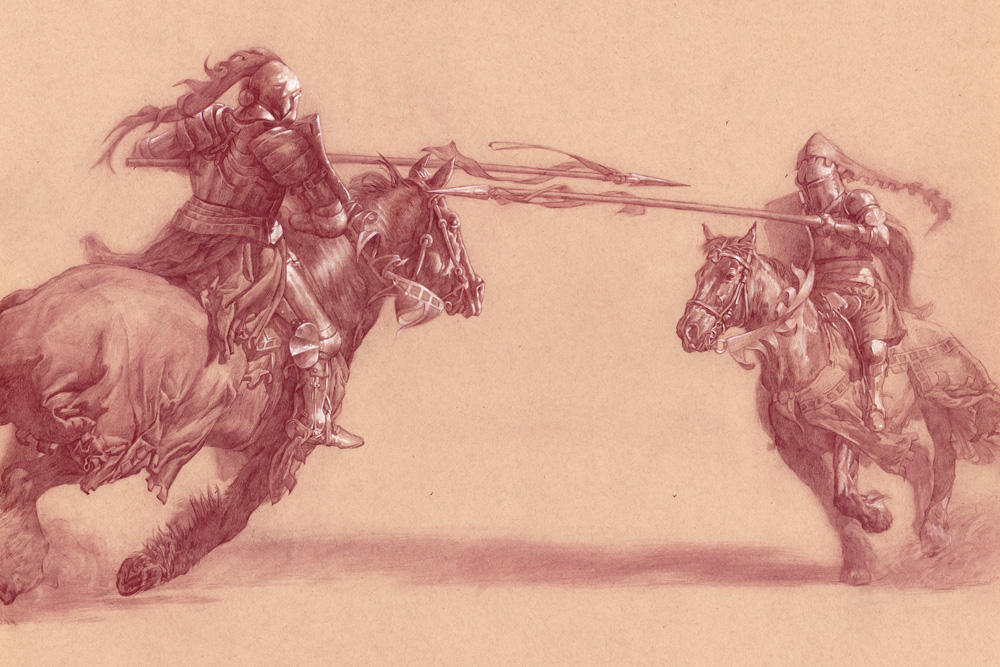
Jousting, by Michael C Hayes


Jousting includes boxing, wrestling, parrying, and other nonlethal forms of combat training in an organized setting with predetermined matches. Your money goes into finding and paying for the best tutors and sparring partners in town, buying and restocking weapons and training equipment, and other costs.
  1. You accidentally injure a petty noble, drawing the wrath of their house. They convince the guard to imprison you to show you what's what. All your weapons, armor, and magic items confiscated, and you have to sit out the next Adventure unless your name is cleared.
  2. Battered and Bruised. First day of adventuring is at -2 Damage. STR Saves to do physical activities (climbing, swimming,...) are at Disadvantage.
  3. The fighting pits ban you! They did say no knives allowed… No Armsman will join you or your companions on your next Adventure.
  4. Fury of the looser. D6: 1-3 Everyone knows your latest strike and calls you Soft Punch, Pudding Sword or something humiliating until you clean your name 4-6: You smashed your best weapon against the ground in anger. It’s now utterly destroyed.
  5. New hairstyle! D6: 1 mohawk 2 dreadlocks 3 braids 4 clean shave 5 mullet 6 top knot. Pick a color; you dyed it too!
  6. An exotic wrestling partner with a thick accent shows up. They constantly brag about their home, and can’t keep their mouth shut. Get a free Rumor.
  7. It wasn’t easy, but you got to join the local branch of the Fight Club. Don’t talk about it.
  8. You get knocked out unconscious in your last sparring session. Wake up.. D6: 1-2 ... with leeches on your arms and chest, and the local physician is pissed at you and claims you owe them for their service; 3-6 ...completely recovered. The local physician is in awe at you as a specimen of physical prowess, and treats you as a superior being.
  9. You accidentally kill your parrying partner. Do a WIL Save. On a fail, start the Adventure with D4 WIL Score loss, as you mentally recover from losing a partner. On a success, you have advantage on WIL Saves for the next Adventure or 1 week (whatever’s lowest).
  10. Some brawly dwarves rolled into town and thought they could out-wrestle you. You lifted 1D10 x 50sp in profits against the beaded ones, plus a Martial Melee/Ranged Weapon (your choice) and a Shield. Plus you got the uttermost respect from their clan now.
  11. Born on the saddle! You impress in a local jousting tournament. Win a fancy Shield worth 10sp and gain a 1 Mule; 2-4 Travel Horse; 5-6 War Horse.
  12. Weapon of choice. Pick the entry you like.

Lecturing (Wizards)

City library


This activity helps a character to delve into lore concerning a monster, location, relic, spell, or similar topics. You might as well be a brain in a jar. Your funds are invested in stocking (or donating to) a library, lending expertise in diverse projects in town (accounting, architecture, etc), lecturing aspiring wizards, and purchasing rare ingredients.
  1. Funding esoteric tomes to be brought into the library, one of them sucks you in upon examination! You’re stranded into a demiplane, whilst your students spend a week figuring out how to bring you back. They’ve spent D6 x 10sp on rare materials that they expect you to pay back.
  2. The transmutation lecture goes awfully wrong! One of your students polymorphs you, and you’re transformed for the next Adventure. You can still talk. 1 Goose 2-3 Donkey 4-5 Hound 6 Ape.
  3. Using ziziphus wax in the lab was not the brightest idea after all… D6: 1-3 you smell of rotten milk, and no amount of water washes it off; 4-6 your skin glows with dim orange light.
  4. What was that cantrip again…? D6: 1-3 Everyone at the library knows that your memory is not the same and starts naming you Cloud-Yeller, or something humiliating until you demonstrate your skill again 4-6: You left your spellbook near the stove and someone snatched it!
  5. New flashy tunic! The motif has... D6: 1 stars of an unknown universe 2 spirals that daze 3 zebra-like stripes 4-5 monocolor birds, lame! 6 a blend of colors that are offensively reminiscent of an old oppressive civilization’s flag.
  6. A visiting lecturer brings some goodies with them. New exotic Spell available at the library for you to transcribe on your spellbook (costs still apply).
  7. The Silver Sages made you an honorary member. No idea what benefits or obligations this entails.
  8. Smelling the interplanar roses knocks you out. Wake up D6: 1-2 ...with a random supernatural mutation; 3-6 … in the middle of a dungeon stark naked. The local cult is impressed by your withstanding of the mutation. They immediately confer to you the rank of High Illuminee, and your have their admiration.
  9. Whilst explaining the properties of different reagents, one of your students explodes in front! Do a DEX Save. On a fail, start the Adventure with D4 DEX Score loss, as your hands get burnt. On a success, you have advantage on DEX Saves for the next Adventure or 1 week (whatever’s lowest).
  10. An anonymous donor funds your next Adventures in the name of discovery. Gain 2D6 x 50sp and a random spell Scroll.
  11. Graduating student! One of your pupils shows some capabilities. They gift you their latest project as a thank you (roll 3d100 on this table, and the Referee chooses entry). Your pupil will join you in any Adventure (D6 HP, Ability Scores 10, D4 random spells from this list).
  12. Clear tea leaf reading. Pick the entry you like.

Proselytizing (Priests)

Church errands


Priests, monks, religious figures of all kinds. You can spend your time attending or oficing rites or by proselytizing in the community. Your hard earned silver can be spent strengthening your faith to everyone’s betterment: aiding orphanages, paying for funerary services to those who can’t afford them, funding new church buildings (or renovations to existing ones), etc.
  1. Your God(s) call you to attend a chess tournament against rivaling deities. Gods take slow turns. You’re gone for a week.
  2. You go on a rampage, partying with your rogue companions. Breaking all your vows; disgracing your faith. For your next Adventure your MD for holy prayers return on a 1 only.
  3. Some fanatics wearing your faith’s symbols turn berserker, and start burning “heretics” alive. Did they steal a loaf of bread now? Word spread around the outskirts of town, and you have to lay low and be discreet. Travel hooded and at night only.
  4. Blasphemy is still blasphemy, even if you did it by accident! 1-3 You owe a favor to the High Priest; 4-6 You have to donate D10 x 5 sp to placate your Church's complaints.
  5. New holy implement! D6: 1 reliquary 2 praying beads 3 goat’s bones 4 wooden effigy 5 silver fork 6 golden chain
  6. Your efforts pleased the one(s) high up. Once in the following adventure, you can spend a turn (10 minutes) communing. Ask a question to them that can be answered with “Yes/No”. You know the answer will be truthful.
  7. A secret order of Knights within your order recruited you. They do the dirty work within your Church.
  8. Misty dream visions are a revelation. Wake up D6 1-2 … from your worst nightmares (lost 2 WIL Score) 4-6 your wildest existential conversation with a deceased Saint of your faith from past times. They owe you one now for your articulated arguments (and the company.. they get lonely).
  9. Your faith is challenged in an existential crisis. This time around, you try to solve it via internal reflection and meditation. Do a WIL Save. On a fail, start the Adventure with D4 WIL Score loss, as your faith and wits are just not right. On a success, your faith is restored have Advantage on WIL Saves for the next Adventure or 1 week (whatever’s lowest).
  10. The faith is spread, and stronger than ever in town. You personally get 2d6 x 25sp in donations, as well as a previously thought lost tome of your faith.
  11. You’re becoming a living Saint! 2D4 pilgrims (Torchbearers) start following you, including to your adventures, as long as you follow the holy faith.
  12. Prayer wheel. Pick the entry you like.

Friday, October 18, 2019

3) Servants Dorm

This is a room for the Raxxe Haunted Manor - Manor Quarters
There are many more to come, but at least I got the 3 of Spades!
The first box gives a brief overview of:
1) the shape and what's in the room to interact with
2) is there something potentially hostile inside?
3) any valuables
4) hidden features/doors/trinkets.


  • 🏚️ L-shaped. 4 bunk beds; poor lighting; opposite to entrance candles glow low
  • 💀 3 imp devils: Ozzis, Nük and Issgar
  • 💰 d20 reduced severed bugbear heads in a jar; scroll of polymorph; 800gp.
  • 🔑Worthless Trinket

  • Well kept large dormitory, L shaped.
  • 8 beds (4 bunks, two on each wall). Servants of the Raxxe family called this space home before turning undead.
  • Faint light at the far end, its source hidden by the room’s shape.
  • A worthless (in economical value) trinket is in the room. Priceless item for the rightful owner; memories of the staff that once lived here. The characters have to search the room for a turn to find it. Roll a d6 on their next encounter with a member of The Raxxe Family (excluding Sasha, Ludwig and Isabelle). On a 1, the reaction towards the characters will be friendly.
d4 Worthless Trinket
1 An iron comb, with the motif of a lion, that’s missing two teeth.
2 A small locket with the picture of a young blond man.
3 An oversized belt, with the head of a bearded smiling dwarven lady on the buckle.
4 A love letter addressed to Hammond. Awful poetry.
  • Three imps have taken residence at the end of the L shape: Ozzis, Nük and Issgar. Candles light their lair.
  • Unaligned for now to any other faction in the Manor, want no part in the current nonsense. The right argument could convince them to change their minds.
  • Goal: get the willing souls of innocent people. Their own contracts refrain them from getting their hands dirty, so they let others arrange these victims. All soul deals in writing, of course. For every soul they pay HDx200gp.
  • If characters manage to drive the imps away, this is a safe room to hide or rest. Don't roll for a Random Encounter if that’s the case.
  • Ozzis keeps d20 reduced severed bugbear heads in a jar, Nük a scroll of polymorph and Issgar a chest with 800gp.
Imp Devil (Trio)
AC: 14
HD: 3, d6
Move: Standard, Double Fly.
Attack: d4 Poisoned Stinger
  • Can change form at-will to a raven, a big spider, or a rat.
  • Can Detect Magic at will and become Invisible at will.
  • The Poisoned Stinger attack requires a save vs poison on a hit. On a fail, additional 4d10 poison damage.
  • Immune to poison, fire damage and mundane weapons and attacks.

Friday, October 11, 2019

Ynn Review

This is an impressions post about the Gardens of Ynn, by Emmy Allen/Cavegirl. If you're not familiar, then you should do yourself a favor and get the 5$ pdf and give it a read. Its follow-up Stygian Library got an Ennie award this year, so the praise is there.

Credentials: I've run 5 sessions in Ynn. So take this write-up with my impressive curriculum into consideration.

Generation Mechanics

Ynn is a pointcrawl, where you focus on distinct locations, and throw away precise dungeon mapping.
This is refreshing, and has a lot of great potential and replay value.

If the intent is generation at the table, on the fly, I can see several problems. The most pressing one is the number of rolls and consultations (= page flipping) necessary for every time the PCs decide to "Go Deeper". You would need to do:
  1. Roll d20 for Location + consult entry (= page flipping)
  2. ... some Location entries require extra rolls
  3. Roll d20 for Details + consult entry (= page flipping)
  4. ... some Details entries require extra rolls
  5. Roll d20/d12 for Events
  6. ... several Events require a d20 roll on the Daytime Encounters or Night-time Encounters + consult monster entry (= page flipping) 
That's between 3 and 5 rolls, flipping to at least 3 different pages, and parsing that information. A Referee skilled in improvisation, or one that is very quick in parsing information and flipping pages might succeed. I suppose it's possible to just give the Location and Details names to the players to chew on, whilst you start eyeing the entries. Or have color-coded dice and roll for Location, Details, and Encounter all at once. But this seems gimmicky.

Rolling some entries before the session seems advisable, but kind of kills the beauty of the Gardens, where everyone at the table, including the Referee, are surprised by each delve into Ynn. Not to speak of characters actions having consequences on the Depth to be applied to the rolls.

Thankfully, there are some useful online rollers for the generation that can help to simplify the process at the table. You should bookmark the links, or try to create your own if you plan to add your own table entries. I've personally used these on sessions to generate content as we go, and can vouch for them as a necessary resource.

Layout & Art

Art was taken from public domain and  added to the text. It sells the eerie atmosphere and its serviceable. At some pieces the art seems pixelated, and I would've liked some extra appearances for the monsters section. Both for my own inspiration, and to show to my players.
Hermit Bottle Crab anyone?


Layout works, and I like page numbers referenced in the tables. Tables are separated and can be found in two parts of the book, and I would've liked to see them all together at the beginning. But that's a minor quibble, and a nitpick. Nothing that can't be solved with a couple post-its, or printing the right pages.

Rumor has it that a "premium" version of the book, with refined layout & art is on the works. So I would hold off on getting a physical copy to snatch that upcoming treasure.


Content

  • The Locations+Details tables are very evocative of a Fae-Land, reminiscent of unattended magical gardens where everything seems familiar but not quite. Think Alice in Wonderland and Narnia, but sprinkle it with a good measure of alcoholism and artistic abandon. So far my players have wanted to explore more of the Gardens.
  • Bestiary entries are mainly animals and constructs, unless the players go really deep into Ynn. This is not a huge problem, but means that your PCs will have less chances to parley or talk with Ynn inhabitants.
    Consider adding more humanoids or at least talking creatures into the Bestiary.
    • Also noticed that the stats for some monsters are wrong (the Emerald Serpent has 65HP); so keep an eye out for these kind of obvious typos.
  • There are useful tables of Treasure, I search the body and I search the flowerbed. This is a nice addition and touch, and I thank the author for putting them in. They won't work in a gp=xp game, the rewards seem a bit too low for that. Consider changing your advancement system to reward exploration, or changing the tables reward quantities.
  • The Events table has already ingrained the monster's reactions. Your usage of that will vary, depending on if you prefer use reaction rolls or weigh more the influence your players have on the situation.
  • There is a new class in the book, The Stranded Changeling. To be completely frank I can't see myself using it.


Conclusions

  • Even though I own the softcover copy already, I would in a moment's notice drop the cash for the premium/reworked version with better referencing, layout and premium art.
  • The entries and feel of the setting are evocative and interesting, for both me and the players. The generation mechanics greatly assist achieving that.
  • Generation mechanics can be tough to do "on the fly", so either you use online rollers, or the Referee has to roll locations and prepare the exploration of Ynn in advance (including encounters, etc), which kind of detracts from the beauty of the module.

Thursday, October 3, 2019

Medusae Menagerie, the RPG

Found out about the 200 word RPG challenge, you can read more about it here.
Funny idea, had to type a tiny little game. Here is my submission. It's about Medusae, and their wyrd social dynamics whilst attending a show at the Opera. It could be played in ~20 minutes, as presented.

A gang of Medusae. Going to the Opera.
Each player rolls for hair type in secret (expand the table at your discretion):
1. Snakes
2. Gooses
3. Wasps
4. Worms
5. Octopuses
6. Suricates
Petrifying gaze and charm apply to all.
Medusae and players can't look at each others heads during the Opera.

The Opera is divided in three Acts.

Act one, Presence. Go in rounds, one-by-one, complimenting each others appearance.
Heads are a sensitive area to avoid.
Compliment for 10 minutes, or until a Medusa takes more than 2 seconds to come up with one.
If the latter, that Medusa has to leave the Opera.

Act two, Invitation. A ticketing fault duplicated invitations. Randomly pair Medusae in twos.
Each pair has to agree on who gets to seat and attend the Opera. The Iron Butler can be called, but he won't help.
If after 5 minutes there is no agreement on who leaves, both do.

Act three, Performance. Each Medusa secretly writes on paper an adjective describing the Opera.
The Medusae have 2 minutes to ask each other questions that can be answered with yes/no.
If they find the description, the remaining WON.
Otherwise they all LOST.